
This post may contain affiliate links which means I may receive a commission for purchases made through links. Learn more on my Private Policy page.
Research-based guide: Product details are attributed to the linked sources. We have not carried out an independent hands-on performance test.
Affiliate disclosure: Retailer links may earn us a commission. As an Amazon Associate, we earn from qualifying purchases. Check the retailer for current terms.
Sanding-tool selection starts with the surface and the intended finish. Hand sanding and powered sanding are different approaches, and a low purchase price does not establish that one tool suits every material or shape.
Hand sanding for a specific shape
A hand sanding block or purpose-shaped support lets you choose how the abrasive contacts the surface. Consider whether you are working with a broad flat area, an edge or a contour. Match the abrasive and approach to the material and finish-maker’s requirements rather than following a universal grit recommendation.
Random-orbit and sheet-sander examples
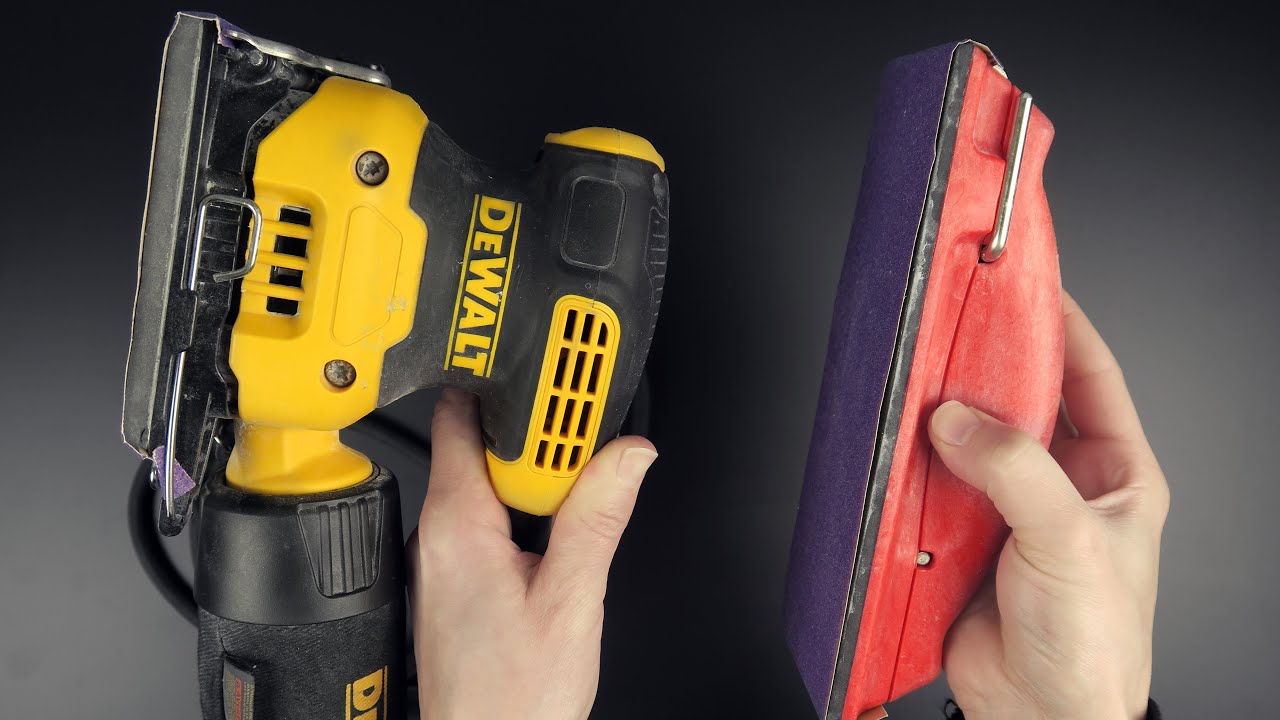
BLACK+DECKER identifies BDERO100 as a five-inch random-orbit sander using hook-and-loop sanding sheets. DeWalt identifies DWE6411 as a quarter-sheet palm sander. Those descriptions establish different abrasive formats; they do not establish a measured winner for finish quality or removal speed.
Plan the consumables and extraction
Check the required sheet shape, backing and hole arrangement before buying abrasive refills. Identify any dust-collection connections and accessories from the actual manual. A collection bag or canister is not proof of complete dust capture.
Compare the whole project
Think about access, the amount of material removal required and how the surface will be finished. A small detail tool, a larger pad and a manual block may serve different parts of the same project. We have not compared vibration, removal rates or user fatigue.
Before choosing
Obtain the exact model’s instructions and account for compatible abrasives and required setup. Old retailer prices and claims of our own demonstration have been removed. For coatings or materials with special health requirements, follow the applicable guidance and have the work assessed appropriately.
Sources
This post may contain affiliate links which means I may receive a commission for purchases made through links. Learn more on my Private Policy page.


Thanks very much 🙏🙏
"So I just 3d printed one"… Cool! 😀 Great review. I just canceled my palm sander order on Amazon and will get a random orbit instead.
Marry me.
Lindy you should totally try to make some mandalorian armor in correspondence with the ongoing tv show. you definitely have the skill and access to the materials necessary for the job. templates are available online.
I've got one of those random orbital sanders. I've used it a lot while renovating a house and I've grown to hate it.
If you ever over heat the paper while sanding the velcro on the sander will melt which means your paper will just fly off when you try to use it.
I had to buy a replacement head from a 3rd party as supplier they don't sell brand name replacements and it's not perfectly flat. So now the sander has a slight shudder when I use it.
Also the way it does the dust extraction is bad. It pulls it through the mechanism for the random action. Mine got gunked up with dust and I had to disassemble the unit and clean it out to get it working again.
ALSO (last thing) the brand name sand paper is stupidly expensive so I bought a bunch from china which works fine but I think your sander that takes regular flat paper is a far superior option.
i like that you made your own sandpaper to make the test "fair", cool
Preppin' [censored] Sanding Block
Great review!!
Just some FYI on your tools, the primary reason the Orbital Sander has far superior dust collection is due the the sanding pad rotating and a built in fan to cool the motor also doubles as a bit of suction. The Palm Sander is limited to the dust that actually makes it to the holes. It, too, has the same type of Motor Cooling Suction assist but far less dust reaches the holes as they are stationary vs rotating. Awesome video as always… Cheers…